Trailer Breakdown Mobile Repair
What Should You Do When Your Trailer Breaks Down in Atlanta?
Start with scene safety, then collect the details needed to choose between mobile trailer repair, recovery, and an in-shop visit.
Quick Answer
Protect the driver and surrounding traffic first, then gather the information a repair provider needs to recommend the safest next step.
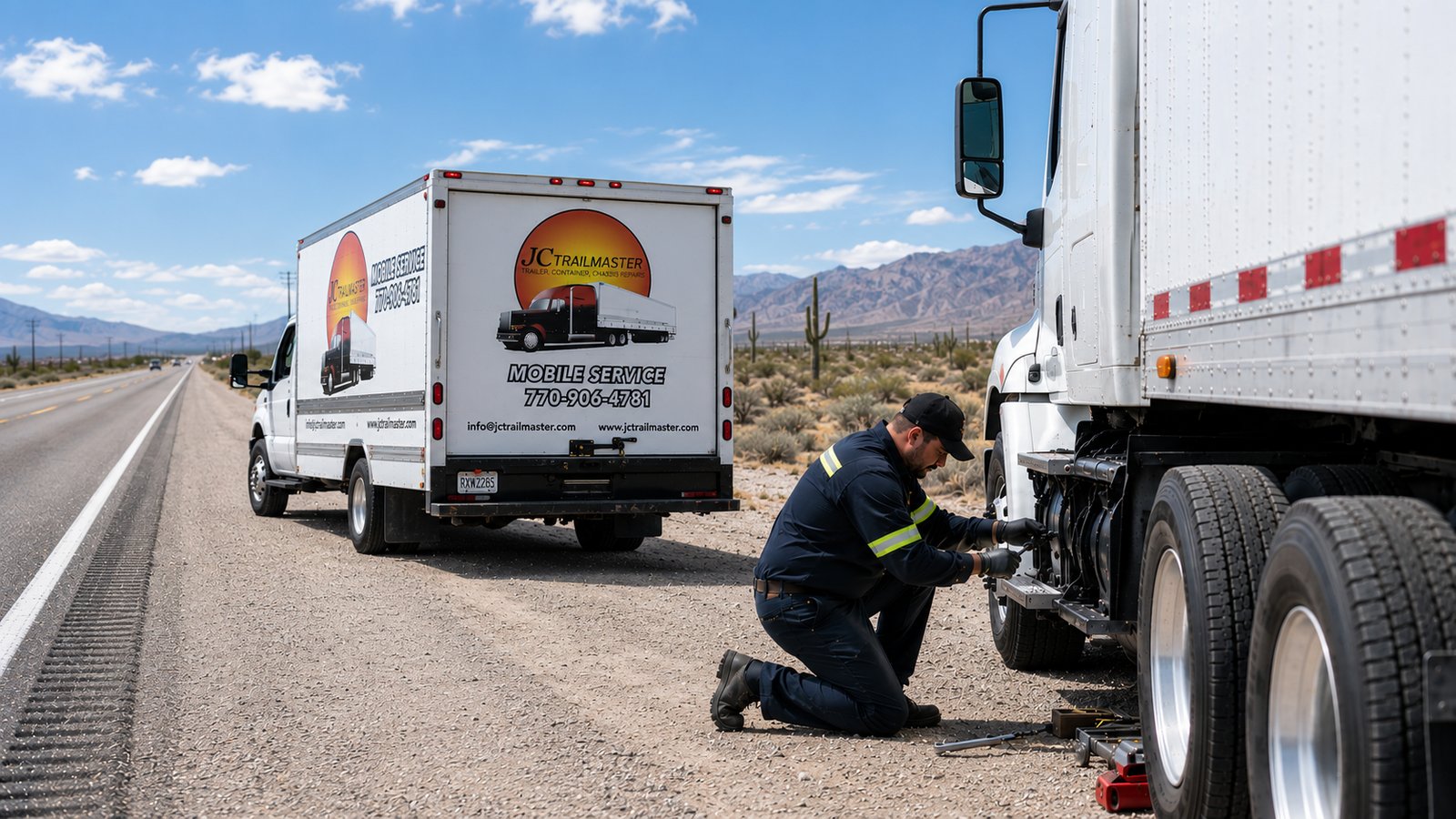
If it can be done safely, move the vehicle out of active traffic, activate hazard lights, and follow applicable warning-device rules, carrier procedures, and roadside-authority instructions. From a safe position, note the symptoms and exact location. JC Trailmaster provides mobile trailer repair during business hours when the location, repair type, access, and current availability make on-site work appropriate.
Safety First
What Should I Do First After a Trailer Breakdown?
A breakdown creates two separate problems: protecting people at the scene and determining what the equipment needs. Do not begin by crawling under a trailer, standing near moving traffic, or attempting a repair the driver is not trained and equipped to perform. Follow the motor carrier's procedures and instructions from police, highway-response personnel, or other roadside authorities.
Protect the Scene
If it can be done safely, move out of active traffic. Activate hazard lights and follow applicable warning-device rules and carrier procedures.
Identify the Symptoms
From a safe position, note what the driver saw, heard, smelled, or felt before the trailer stopped operating normally.
Share Your Location
Provide the road, direction of travel, nearest exit or cross street, yard or dock, and any access limitations.
Call for Service
Describe the equipment, load status, and symptoms so the repair provider can assess whether mobile service is appropriate.
Federal motor-carrier regulations require hazard warning flashers and external warning devices in specified stopped-vehicle situations. Conditions and applicable requirements vary, so drivers should follow current regulations, company policy, and on-scene instructions rather than relying on a general website guide for placement decisions.
Problems Across Metro Atlanta
What Are the Most Common Roadside Trailer Failures?
Roadside failures often begin as developing wear, an intermittent fault, or minor damage that becomes more serious under load. Brake and air-system problems, electrical faults, damaged tires, overheated wheel ends, suspension failures, and door or structural damage can all prevent a trailer from continuing safely.
The symptom does not always identify the failed component. A trailer that pulls may have a brake, tire, suspension, axle, or loading issue. Pressure loss may come from a hose, fitting, chamber, valve, or reservoir. The driver's observations help the service truck arrive prepared; the technician still has to locate the failure before deciding what can be repaired on-site.
Cargo Changes the Response
What Changes When a Disabled Trailer Is Loaded or Refrigerated?
Tell the repair or recovery provider whether the trailer is loaded, the approximate cargo weight and distribution if known, and whether the load may have shifted. Load weight affects stabilization, lifting, tire and suspension work, towing, and the choice of recovery equipment. A leaning trailer, damaged landing gear, suspension failure, or shifted load can create hazards that are not obvious from the failed component alone. Do not open doors, release securement, or enter an unstable trailer merely to inspect the cargo.
For refrigerated cargo, report the temperature requirement, current temperature information available to the driver, alarm status, and how long the unit has been stopped. Trailer running-gear repair and refrigeration-unit service are different scopes, so confirm which provider is addressing each problem. Follow the carrier's cargo-protection and product-handling procedures; do not assume a mechanical trailer repair resolves a temperature-control concern.
Hazardous materials, high-value cargo, sealed loads, livestock, or other restricted freight may require additional carrier, shipper, emergency-response, or law-enforcement instructions. State those restrictions during the first call. The immediate plan may need to coordinate scene safety, cargo transfer, recovery, and repair rather than treating the event as a simple parts replacement.
Can Mobile Technicians Repair Trailer Electrical Problems?
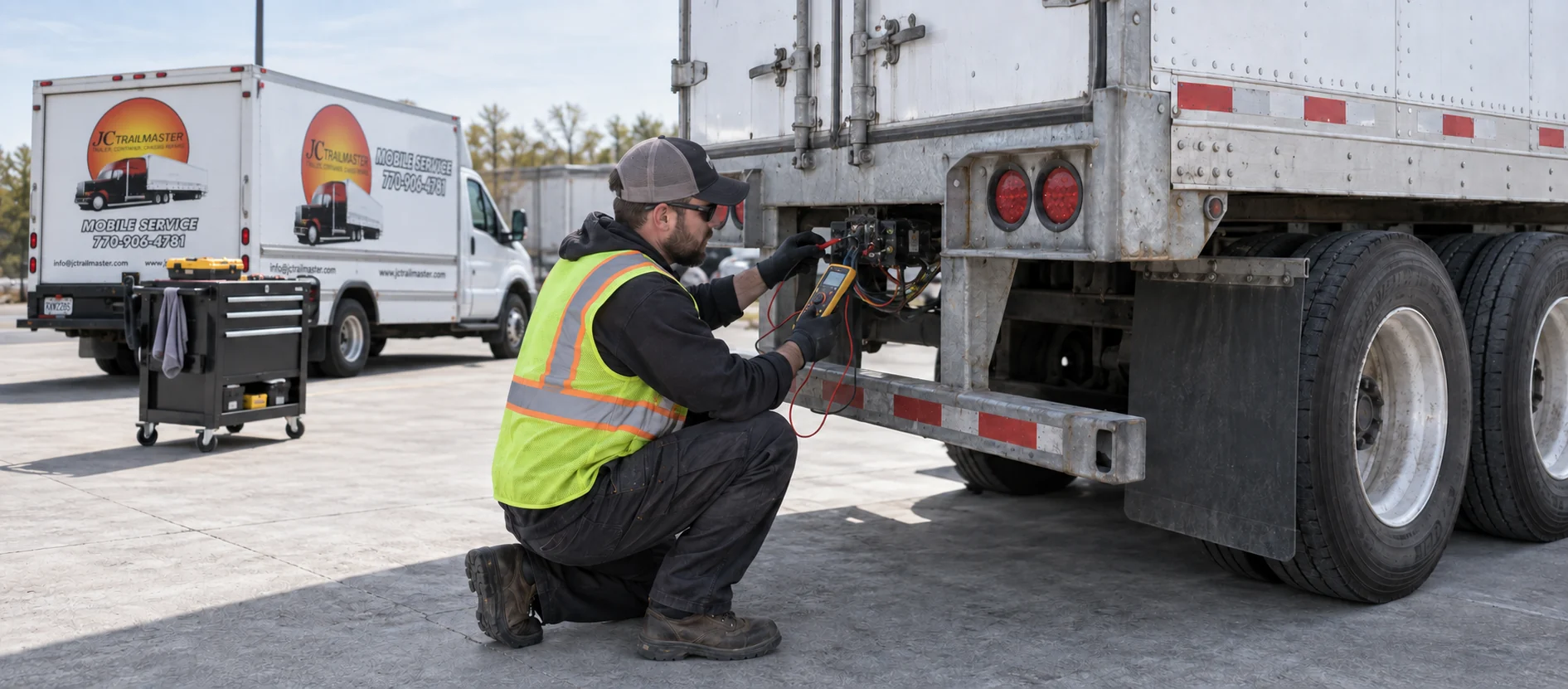
Many lighting and electrical problems can be diagnosed at the trailer's location. Mobile work may include lamps, wiring, harnesses, connectors, grounds, junction boxes, and accessible ABS electrical faults. A technician can test the circuit to determine whether the problem is isolated or part of wider damage.
Intermittent faults can take longer to trace because vibration, moisture, corrosion, damaged insulation, or loose connections may cause the problem to appear and disappear. Extensive harness damage or work requiring controlled shop access may be scheduled for the Ellenwood facility.
Mobile Repair or Recovery?
When Should I Call Mobile Trailer Repair Instead of Towing?
Mobile service may avoid unnecessary recovery time when the trailer is accessible and the likely repair can be completed safely with a service truck. Towing or specialized recovery may be the safer choice when the location cannot support repair work, the unit cannot be stabilized, or the damage requires equipment and working conditions available only in a shop.
Mobile Service May Fit
- The unit is in a location where work can be performed safely
- The fault appears accessible to a mobile technician
- The trailer can be stabilized without specialized recovery
- The repair involves available tools and parts
- Yard or dock service can reduce unnecessary movement
When Mobile Repair Is Not the Right Fit
- The stopped location exposes the driver or technician to traffic
- Collision or structural damage is extensive
- The unit cannot be safely stabilized where it stopped
- Fabrication or specialized shop equipment is required
- Diagnosis shows the repair cannot be completed on-site
Can Mobile Service Fix Trailer Brakes and Air Leaks?
Some brake, ABS, and air-system failures can be diagnosed or repaired on-site. The technician may inspect accessible brake components, chambers, hoses, fittings, valves, wiring, sensors, and visible damage. An air leak may be repairable if the failed component can be identified, reached, and safely serviced at the location.
Safety-critical systems require a complete assessment. If the problem involves extensive damage, unavailable parts, unsafe working conditions, or a repair that needs shop equipment, the next step may be recovery or an in-shop appointment rather than a temporary roadside fix.
Before Returning to the Route
What Should Be Confirmed Before the Trailer Moves Again?
A symptom disappearing is not the same as a completed repair. Before movement, the responsible driver or carrier should understand what failed, what work was completed, whether any limitation remains, and whether a qualified inspection or additional shop work is required. Follow the repair provider's instructions, carrier policy, and applicable regulations for return to service; this guide cannot determine whether a specific unit is safe to move.
Recheck the items relevant to the original complaint. That may include air-pressure behavior, brake application and release, ABS or other warning indicators, required lamps, tire condition, wheel-end heat or leakage, suspension position, landing gear, coupling connections, and whether doors or cargo are secured. A brief controlled check may be appropriate only when directed and when the location permits it safely. If warning signs remain or return, stop and request further evaluation rather than extending the route to “see if it clears.”
Keep the service record, note any follow-up recommendation, and tell the next driver or maintenance contact what occurred. If the roadside work was temporary or limited by access, parts, or working conditions, schedule the documented follow-up before the unit is dispatched beyond those limits.
Can a Broken Trailer Door Be Repaired On-Site?
Door hinges, latches, rollers, seals, and related hardware may be repairable where the trailer is parked. The technician must determine whether the problem is limited to the door or whether the surrounding frame, header, floor, or body has shifted or been damaged.
Major alignment problems, collision damage, extensive structural work, or fabrication are generally better handled at the shop. Do not attempt to force or secure a damaged door in a way that could release unexpectedly or place someone beneath an unstable component.
Business-Hours Mobile Service
Mobile Trailer Repair in Ellenwood and Metro Atlanta
JC Trailmaster dispatches mobile service trucks to eligible yards, docks, and roadside locations throughout metro Atlanta and surrounding communities. The Ellenwood shop also handles repairs that require structural work, fabrication, specialized equipment, or longer access to the unit.
Mobile service is offered during stated business hours. Response and completion timing depend on location, traffic, current workload, technician availability, diagnosis, parts, and working conditions. Call with the information in the checklist so the team can assess the request accurately.
Areas We Serve
Breakdown and Mobile Repair Questions
Trailer Breakdown FAQs
What should I do if my trailer breaks down in Atlanta?
Protect the driver and surrounding traffic first. If it can be done safely, move out of active travel lanes, activate hazard lights, and follow applicable warning-device rules, carrier procedures, and instructions from roadside authorities. Then share the location, trailer type, symptoms, and load status with a repair provider.
Can a trailer mechanic come to me?
Mobile service may be available at eligible yards, docks, and roadside locations during business hours. Availability depends on the location, repair required, access, current workload, and whether the work can be completed safely outside the shop.
When should I call mobile repair instead of arranging a tow?
Mobile service may fit when the trailer is accessible and the likely repair can be diagnosed and completed safely on-site. Towing or recovery may be more appropriate for an unsafe location, extensive collision or structural damage, specialized shop work, or equipment that cannot be safely stabilized where it stopped.
Can mobile technicians repair trailer brakes?
Some brake and ABS concerns can be diagnosed or repaired on-site, depending on the fault, location, equipment, parts, and working conditions. Safety-critical or complex brake problems may require recovery or an in-shop repair.
Can mobile trailer repair fix an air leak?
Many accessible leaks involving hoses, fittings, chambers, valves, or connections may be diagnosed and repaired on-site. The technician must first locate the leak and determine whether the system can be repaired safely at that location.
Can trailer lights and electrical faults be repaired on-site?
Yes, many lighting, wiring, connector, ground, harness, and junction-box issues can be diagnosed and repaired by a mobile technician. Intermittent or extensive faults may require additional testing or shop access.
Can a broken trailer door be repaired on-site?
Door hinges, latches, seals, and related hardware may sometimes be repaired where the trailer is located. Damage involving the surrounding structure, major alignment problems, or fabrication may be better handled at the Ellenwood shop.
How quickly can a mobile technician respond?
Response timing depends on the location, traffic, current workload, technician availability, and the repair required. Call during business hours to confirm availability and an estimated arrival time.
Plan Before the Next Route
Build Mobile Repair Into a Fleet Maintenance Plan
Preventive maintenance cannot eliminate every breakdown, but it can identify developing brake, air, electrical, suspension, wheel-end, and structural concerns before they interrupt a load.
Read the Atlanta semi-trailer repair guide →25+
Years of Experience
10,000+
Repairs Completed
Insured
DOT Registered
#3782640
USDOT